


Vietnamese Robusta Coffee: Understanding Vinh Hiep’s Product Range
You want to develop a coffee, but the green-bean catalogue begins with names such as S16 Clean and S18 Standard. Those names describe useful parts of the ingredient. They do not yet tell you which one will work in the drink you plan to sell. Understanding the range means knowing what each part of a product description answers, then choosing a starting sample for your own application.
Vinh Hiep’s green coffee catalogue presents Vietnamese Robusta coffee in named screen and grade lines. If you are new to buying green coffee, begin with the product stage and intended use before comparing every option. If you already roast an established recipe, use the ingredient you know as your reference. The same catalogue can serve both decisions without assigning one screen size to beginners and another to experienced roasters.
Robusta identifies a coffee, not a finished flavour
Robusta is the commercial name commonly associated with Coffea canephora. World Coffee Research’s Robusta catalogue describes the species and its varieties. That botanical background is useful when distinguishing Robusta from Arabica, but it does not establish the variety or tasting result of a product merely labelled Robusta.
A green coffee product has more detail than its species. Its physical specification, origin information, processing and condition contribute to what a buyer needs to understand. Roasting and brewing then contribute to the finished beverage. The name Vietnamese Robusta establishes a broad starting point; the actual ingredient still needs to be selected.
For a roaster developing an espresso blend, the task is to decide what the proposed component should contribute to the recipe. For a phin product, the task is to test the coffee in the intended preparation and serving style. Neither decision can be settled by a general reputation for the species.
It is helpful to write the product goal in plain language before choosing. Perhaps you want to retain a familiar house blend while changing one ingredient. Perhaps you are building a new coffee to serve with milk. That sentence gives the trial a purpose. Technical terms can then support the decision rather than replace it.
Green beans and roasted coffee are different buying tasks
The green coffee category contains an unroasted input. The buyer still needs a suitable roast and brewing approach, whether those tasks happen in its own roastery or through an agreed production arrangement elsewhere. A green specification is therefore the beginning of product development, rather than a ready-made description of the final cup.
When looking at photographs, check the material being shown. Pale green beans, parchment coffee, whole cherries and roasted brown beans represent different stages. A photograph of cherries can explain origin work; it should not be read as the physical specification of the green product you will receive.
The distinction also matters when sharing requirements. A request for a green Robusta component can be evaluated against named product lines. A request for a finished beverage requires a different discussion. Make that choice early so the conversation follows the product you actually intend to buy.
For someone starting a roasting business, a manageable first step is to select one drink application and discuss one candidate line. S16 Clean is a possible starting point because its published defect and foreign-matter limits give you a defined physical basis for the trial. Whether its cup suits the product must be established by testing.
What the S13, S16 and S18 descriptions tell you
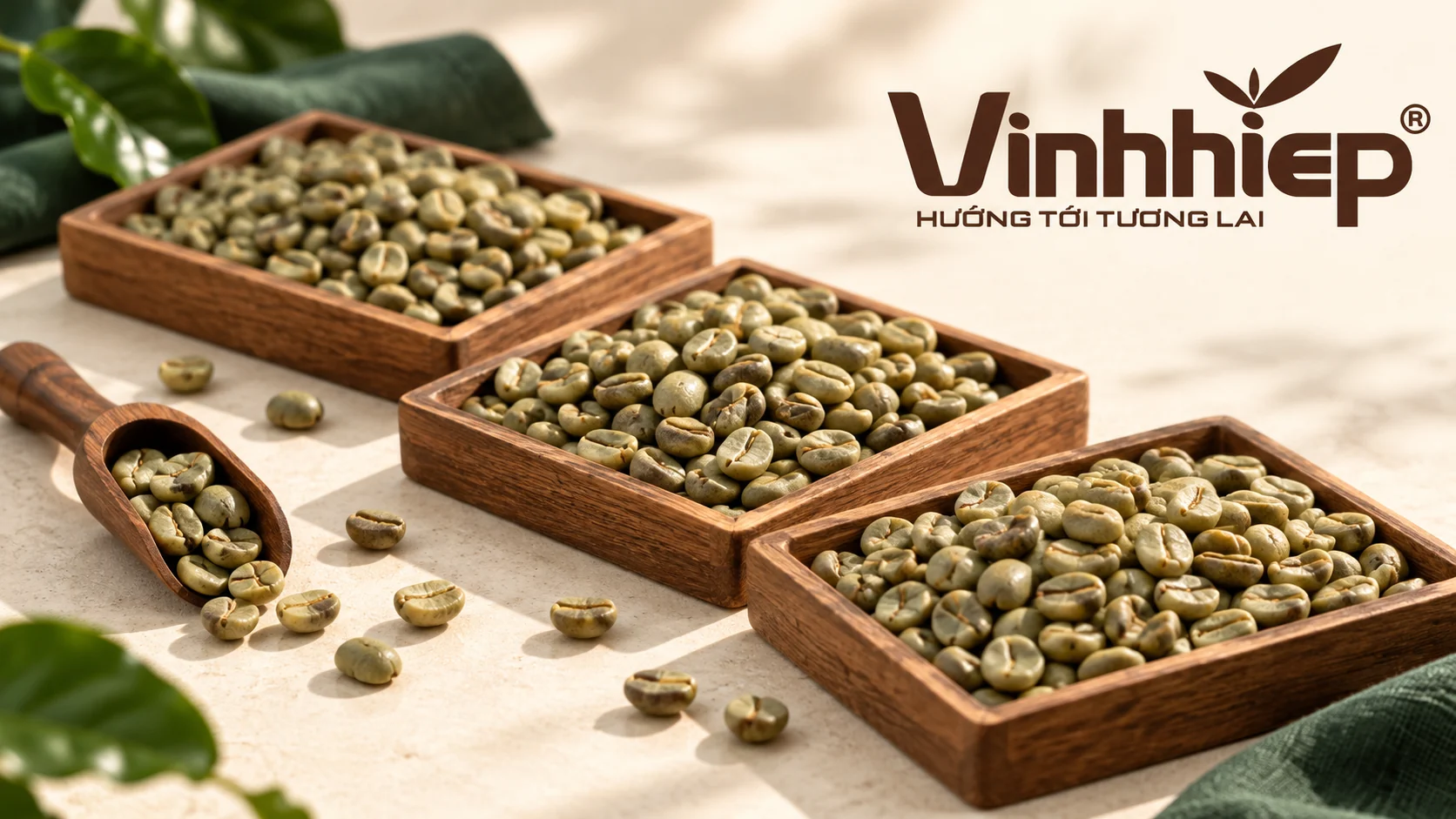
Screen names belong to size classification. They help a buyer distinguish product groups in the catalogue and communicate which line is being considered. Size is relevant physical information, but it should remain one part of the specification rather than becoming a shorthand for all aspects of quality.
Vinh Hiep’s range includes S13 descriptions alongside S16 and S18 lines. Within the English catalogue, the available product pages let you identify the exact line and the published screen requirement. Read the complete statement, including whether a percentage is a minimum, rather than keeping only the number in the product name.
A minimum screen percentage is a specification statement. It is not a claim that every bean has identical dimensions, and it is not a sensory result. When comparing an ingredient with the coffee you already use, determine which physical conditions you need to preserve and which change you intend to investigate.
If your question is specifically whether to move from one screen group to another, keep the purpose narrow. Select an appropriate candidate and assess how it behaves in your own development work. Do not assume the larger designation belongs in espresso, or that the smaller one is restricted to a lower-value use.
Clean and Standard belong to the named product specifications
The catalogue also uses Clean and Standard. In this range, those names lead to product pages with distinct limits. They should be read in relation to those published products, rather than treated as universal definitions that every supplier applies identically.
For instance, the S16 Clean page lists black and broken beans separately, while S16 Standard presents a combined black-and-broken limit. The foreign-matter limits also differ. Both pages still need to be read with their moisture and screen statements. The grade name is a convenient label for that wider description.
If your existing requirement separates black beans from broken beans, this difference changes how you compare an offer. You should retain those separate requirements in the purchasing discussion rather than replacing them with a combined figure that answers a different question. That is a specification decision before it becomes a tasting decision.
The Clean versus Standard guide gives the numerical comparison. Here, the important habit is to connect a name with its stated conditions. No catalogue label, including Clean, confirms a particular flavour, a processing method or a current certification unless that information is separately supplied.
Read the conditions around a number
An upper limit and a measured result are different kinds of information. If a page publishes a maximum moisture content, that tells you a condition of the described product. It does not report the actual moisture of every sample you might receive. The same distinction applies when reading defect limits.
When a requirement matters for production, keep the qualifier with the value. Copying only the percentage into an internal comparison can change its meaning. Retain the parameter name as well: foreign matter is not the same category as broken beans, and a combined limit is not two separate limits.
This is easier to manage when one product name stays attached to your notes. Record which page you used, which sample was assessed and what the evaluation showed. A short, clear record allows another person in the roastery to continue the work without guessing which S16 line you meant.
You do not need a large grading exercise for every early conversation. You do need enough precision to avoid choosing one product on the assumption that it carries another product’s specification. Once the candidate is clear, discuss the line you want to test with Vinh Hiep, explaining the drink or existing ingredient behind the choice.
Choose a first product without creating too many trials
For a new product, start where the customer will experience the coffee. A milk-based espresso drink, a black espresso and a phin served with condensed milk create different development questions. Choose the intended preparation first so the initial evaluation can reveal something useful for that product.
Next, choose a manageable candidate. S16 Clean may be a starting discussion when you want published separate defect limits; another named line may better match an existing physical requirement. This is a way of narrowing the work, not a promise that one line delivers a predetermined taste.
Evaluate the sample with a recorded roast and preparation. Note what you actually perceive and what needs to change. If the result suggests further development, make the next trial answer one clear question. You might adjust the roast for that ingredient, or compare it with another candidate while preserving the intended preparation.
Receiving many samples can be useful when a roastery has a defined evaluation programme. For a first product, too many unstructured comparisons can make the choice harder. A small number of purposeful trials leaves more time to understand why a candidate deserves further work.
When you already have a recipe
Keep the current ingredient as your reference. Describe what you want to retain in the drink and what you are willing to change. During the first comparison, keep the remaining blend components and proportions identifiable so the proposed ingredient can be assessed in context.
Then distinguish a comparison roast from a development roast. The first helps you observe differences under a stated approach; the second explores whether an adjustment improves the result for the new ingredient. They serve different purposes. A disappointing first roast should lead to a reasoned next step, rather than a claim that an entire screen group is unsuitable.
Physical information and the cup work together
Green coffee can be assessed physically and sensorially. The Specialty Coffee Association’s Coffee Value Assessment separates physical attributes from descriptive, preference-related and informational aspects. That separation is helpful as a concept: bean size and defects are not the same observation as aroma, taste or a buyer’s preference.
For your production decision, organise the observations around use. If the coffee will form part of a blend, evaluate the blend as well as the ingredient. If customers will prepare it at home with a phin, include that method before finalising the product. A general tasting impression needs to reach the actual way the coffee will be consumed.
Give uncertain observations room to be checked. If a characteristic is unclear, record it as an observation to revisit rather than borrowing a familiar tasting note. The next trial can test whether it persists under the same conditions or changes with the roast and preparation.
This approach protects the origin story as well. A regional description can explain where the coffee comes from; it should not supply flavour notes that were never observed. Using Gia Lai coffee origins in a product range explains how to connect those different types of information accurately.
A catalogue line and the proposed supply
The catalogue gives you a product to discuss; a purchasing offer establishes what is being proposed for your request. Keep those stages connected. If you tested a sample under one product name and the offer identifies another, resolve the change before treating the evaluation as approval of the purchase.
The same applies when the requirement includes a particular origin. A company can work in Gia Lai and present several green coffee products without every page establishing the growing origin of every future shipment. State the origin requirement alongside the named line, then confirm the information for the proposed supply. This lets your team make two clear decisions: whether the ingredient suits the drink and whether the purchase meets the origin conditions you intend to communicate.
Move from the range to the purchase you need
Once a candidate has earned further attention, quantity, packaging and destination become easier to discuss. Use the exact product name and explain whether the next step is another evaluation or a purchase enquiry. That helps the response address the decision you are currently making.
For a ready purchase discussion, indicate the estimated green coffee requirement and receiving destination. Confirm the available product and commercial conditions before assuming a sample arrangement, delivery schedule or minimum order. The catalogue provides a product range; transaction terms are confirmed for the request.
Contact Vinh Hiep about your chosen Robusta line when you are ready to continue. If the main difficulty is organising the supplier choice around your operation, choosing a supplier for your roastery gives a practical route from application to enquiry.
The Vinh Hiep supplier overview connects the range with the company. The green coffee knowledge and coffee sourcing sections provide technical and purchasing explanations when you need them. The useful outcome is a named ingredient and a clear reason to test or purchase it, grounded in your own product.
Sources
- World Coffee Research, Robusta varieties catalogue: species and variety context, not identification of a Vinh Hiep lot.
- Vinh Hiep, S16 Clean: product naming and published physical specification.
- Vinh Hiep, S16 Standard: combined defect limit and other product conditions.
- Specialty Coffee Association, Coffee Value Assessment: distinctions between physical, sensory and informational assessments.