

Vinh Hiep Coffee Supplier: Products, Facilities and Partnerships
A roaster usually meets a coffee supplier through a product: a name on an offer, a sample of green beans, or a requirement for the next production run. The company behind that product matters because growing, processing and trading all contribute to the route from harvest to roasting. Vinh Hiep’s published history connects the business with Gia Lai, agricultural processing and direct exports. Its current website gives buyers a practical place to begin with named green Robusta products.
To explore the Vinh Hiep coffee supplier range, start with our green coffee products. Choose a product in relation to what you intend to roast. A first trial for a new espresso blend needs a different starting discussion from replacing an ingredient in an established recipe. The sections below explain how the company’s published activities and product information fit those decisions.
A business history connected with Gia Lai
Vinh Hiep’s company history records establishment in Ho Chi Minh City in 1991, followed by an office in Pleiku, Gia Lai, in 1999. It describes development of coffee and pepper processing activities during that period. The record places the business in an agricultural supply context before the green coffee catalogue a buyer sees today.
The same history records the transition to Vinh Hiep Co., Ltd. and the beginning of direct exports in 2004. It also describes facility and processing development during 2004–2009, investment in coffee farming in 2014 and the introduction of L’amant Café in 2017. Together, these milestones follow the business from agricultural processing and direct trade into the development of a finished coffee brand.
For a buyer, this history introduces the relationship between the company, the growing area and its product range. The purchasing discussion then establishes the particular green coffee, quantity and delivery arrangement under consideration. A long history does not remove the need to choose and test the ingredient that will enter your roaster.
You can approach that choice from your own production. If a house blend is already selling, identify the role of the component you want to replace. If you are developing a new product, decide how it will be brewed and served. Those decisions give the supplier something more useful to work with than a request for whichever coffee is considered best.
Green Robusta products give the conversation a starting point
The English catalogue presents green coffee products under screen and grade names. Buyers will encounter S13, S16 and S18 descriptions, including Clean and Standard lines. These names make it possible to discuss a particular product rather than treating all Vietnamese Robusta as one interchangeable ingredient.
For someone without an existing reference sample, Robusta Grade 1 S16 Clean is one possible starting product to discuss. It publishes separate limits for black beans, broken beans and foreign matter. That gives the initial trial a stated physical specification. It does not predict the cup profile, so the next step is to assess the available sample for your intended drink.
A roaster with a working recipe has a more direct reference: the coffee already being used. Keep that reference when evaluating a proposed replacement. Compare the physical requirement you need to maintain, then examine the effect in the finished product. The decision is whether the new ingredient meets your purpose and what, if anything, must change in production.
Product availability, sample arrangements and prices need a current discussion. A catalogue explains the range; it is not a reservation of stock. You can discuss a starting product with Vinh Hiep when you know the drink you are developing or the ingredient you want to replace.
Screen size and grade answer different questions
A screen description concerns bean size classification. Black, broken and foreign-matter limits concern other physical aspects. These details belong together in a purchasing decision, but one should not be used as a substitute for the others. A larger screen number does not establish that a coffee is tastier or more suitable for a particular brewer.
For example, S16 Standard and S16 Clean share a screen designation while publishing different defect and foreign-matter specifications. That makes them useful to examine when the decision concerns grade within a size group. The detailed Clean versus Standard comparison explains how to interpret those differences without turning them into untested tasting claims.
What the published facilities show
The company profile presents infrastructure under names including Vinh Hiep Building in Gia Lai, Ham Rong Organic Coffee Farm, the factory in Tan Uyen industrial area in Binh Duong, and Tra Da Factory in Gia Lai. These are company-published descriptions of its infrastructure. A buyer can use them to understand the range of locations presented by the business.
The useful next distinction is between a company location and the facility relevant to a proposed product. Green coffee, roasted coffee and another agricultural product do not automatically follow the same route. If a purchase has a site requirement, identify that requirement while the product is being selected so the relevant location can be discussed.
Photographs can show buildings, equipment and people at work. They do not, by themselves, establish the present capacity, operating schedule or certification scope of a proposed shipment. For an order that depends on any of those conditions, the decision needs current information tied to the product and activity concerned.
This is especially relevant when a buyer’s internal approval involves more than the roaster. Production may want a repeatable ingredient; procurement may need a confirmed commercial basis; another team may need information about a processing location. Establish the actual decision each team must make, rather than sending everyone a general company presentation and assuming the work is complete.
Keep green coffee separate from the finished beverage
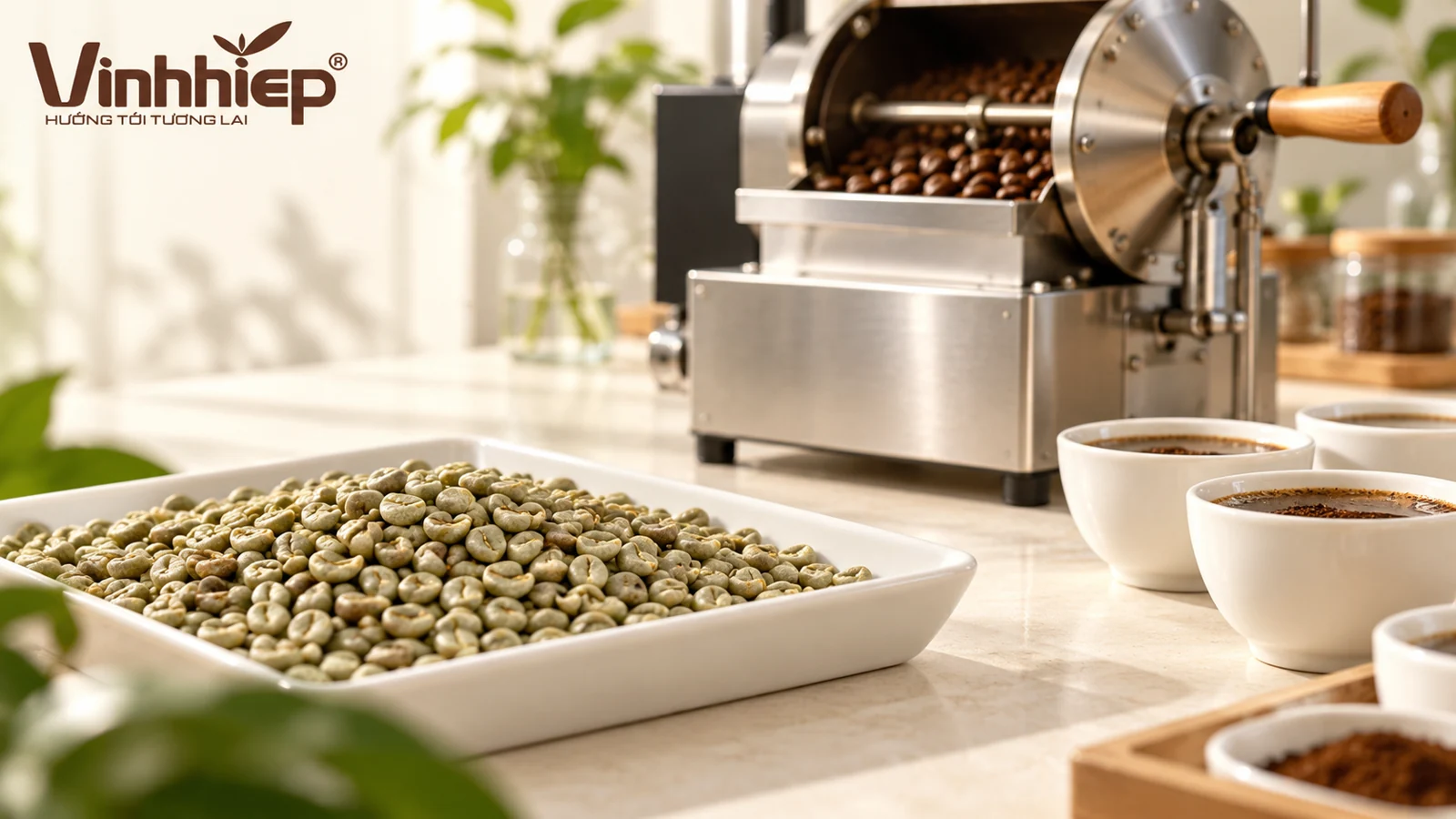
A coffee company can present products at several stages, while a roaster is purchasing one particular input. Green beans still need to be roasted and developed into a drink. A finished coffee brand, a photograph of a cup and a green Robusta specification therefore answer different questions. Start the discussion in the category that matches what you will receive and handle.
For example, a café developing its own label may be deciding between buying roasted coffee and arranging its own roasting. The green coffee route includes a development task: establish a roast, test the brewing recipe and decide how the ingredient will be used. A description of a finished beverage does not establish that an unroasted line will produce the same result under a different process.
An established roastery usually has that development capability already. Its immediate decision may instead be whether a proposed ingredient can enter an existing production schedule. It needs the candidate product and sample evaluation before planning purchasing quantities. Keeping the product stage clear saves time because the company introduction leads directly to the relevant offer.
This also makes feedback useful. Saying that you want to maintain your current espresso blend identifies a job for the green ingredient. Saying that a photograph looks appealing does not yet identify what the supplier should propose. Use the finished drink as the goal and the green specification as the starting material, with the roast trial connecting them.
Partnerships begin with work at origin
Coffee reaches a processing site after work on the farm. Growers have cared for trees, prepared labour and decided how to organise harvesting. Processing then requires coordination around the condition and timing of incoming material. A partnership becomes meaningful when those connected tasks can be organised together.
On 8 October 2021, Vinh Hiep announced a launch and signing event for a high-quality Gia Lai coffee linkage programme covering 2021–2025, alongside its specialty coffee project. The published event report describes participation by local representatives, cooperatives and coffee-growing households. It records an intention to develop production and processing, including discussion of Natural and Honey approaches.
That 2021 event report is a dated record of the announced programme. It should be read in that period. The programme’s aims do not, on their own, confirm achieved results, today’s programme status or the certification of a product now being offered.
For a roaster, the connection with origin can still be valuable. It helps explain why selecting coffee involves more than the last stage of cleaning and packing. If an origin story will become part of your own product, connect the regional context with confirmed information about the coffee you actually buy. Using Gia Lai origins in your product range develops that communication task.
Turn a company introduction into a useful product trial
A first conversation should leave you closer to choosing an ingredient. Suppose you are building an espresso blend for a café that serves both black and milk drinks. Begin with the role the Robusta component needs to play in that blend. Select a candidate product, establish how a sample can be evaluated, and compare it in the drinks you intend to sell.
If you already have a recipe, keep the remaining components and proportions identifiable during the first comparison. Record the roast approach and preparation conditions as well. A trial that changes several ingredients, the roast and the brewing recipe at once may produce an interesting drink, but it gives less information about the proposed coffee itself.
For a new product without a working reference, a narrower first trial is easier to interpret. Choose one brewing use and a manageable candidate range. Note the aroma, taste, texture and aftertaste that matter for that use. Decide which direction deserves a second roast rather than expecting one session to settle every possible application.
After the first session, choose the next step from what you observed: repeat a promising roast, adjust one preparation variable or return to the product specification if a physical requirement remains unresolved. If you want to organise the supplier choice around your own production, choosing a Vietnam coffee supplier for your roastery follows that decision in more detail.
Plan the purchase around the coffee and the destination
Once a candidate product fits the intended use, quantity and delivery become more concrete. The estimated requirement should relate to a production plan rather than a vague wish to buy in bulk. It is easier to assess an offer when both parties know the green coffee line being discussed and where it needs to go.
Packaging is part of that conversation. Consider how the receiving site handles bags, how the coffee will be stored and how quickly it will be used. A packaging format that suits a shipment still needs to suit the roastery receiving it. Confirm the actual format available for the proposed purchase before treating it as part of your plan.
Destination and handover arrangements also shape the discussion. An overseas buyer may be organising freight and import handling; another buyer may be purchasing for delivery within Vietnam. The product can be the same while the practical responsibilities differ. Packaging and shipment planning explains these questions without assuming a fixed delivery service.
Vinh Hiep’s historical export activity provides company context. The terms for a new transaction still need agreement. Avoid building a production launch around an assumed minimum order, lead time or freight arrangement that has not been confirmed for the purchase.
Choose the next step that matches your stage
If you are at the beginning, select a use and discuss a named starting product. If a sample has already been tested, share the result that affects the next choice: the feature you want to preserve, the change you want to investigate or the proposed line you want to continue with. The conversation can then move into the actual purchase.
For a buyer ready to enquire, provide the product name, estimated quantity and receiving destination. Add any condition that would change whether the product can be used. The purpose is to receive a relevant response on the material and terms, rather than collect a larger set of general brochures.
Contact Vinh Hiep about your green coffee requirement to move from company information to a specific product discussion. Our Vietnam coffee supplier overview introduces the business, while coffee sourcing and export and green coffee knowledge provide supporting explanations when a purchasing or technical question needs more depth.
Sources
- Vinh Hiep, company profile and history: dated business milestones and the infrastructure presented by the company.
- Vinh Hiep, S16 Clean: named product and published physical specifications.
- Vinh Hiep, S16 Standard: product-specific information for grade comparison.
- Vinh Hiep, linkage programme launch, 8 October 2021: historical event and announced programme scope.